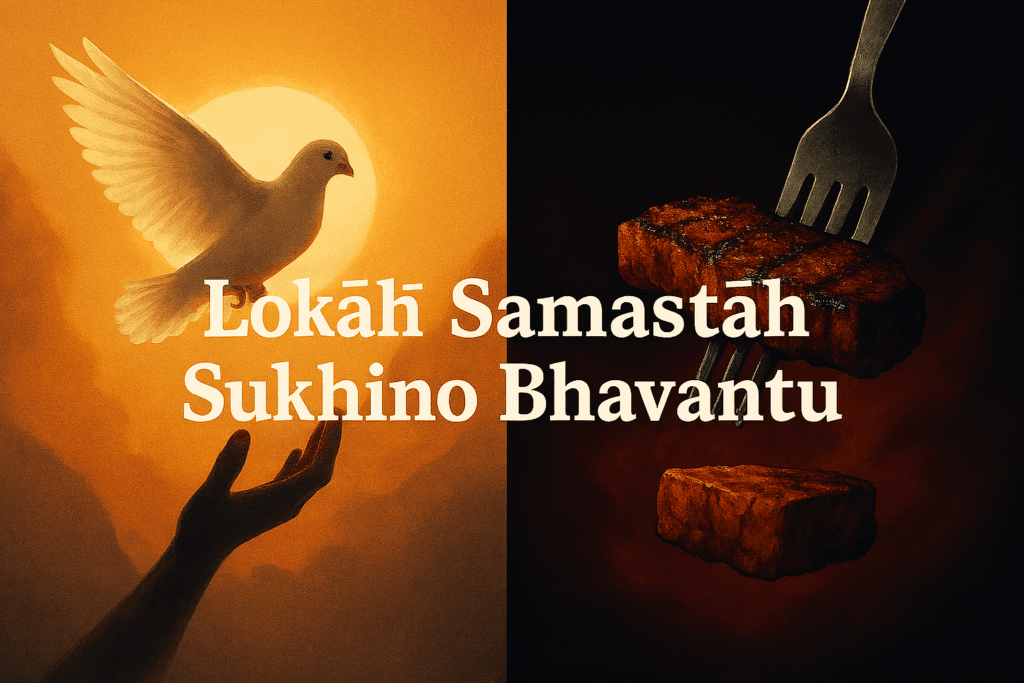
Lokāḥ Samastāḥ Sukhino Bhavantu:
The Mantra of Universal Well‑Being — and the Discomfort of Selective Compassion
There is a moment in many yoga classes when the room softens, the breath settles, and voices rise together in a chant that has echoed through centuries:
Lokāḥ Samastāḥ Sukhino Bhavantu —
May all beings everywhere be happy and free.
It’s a mantra of radical inclusivity. Not “some beings.” Not “the beings I personally like.” Not “the beings whose suffering I’m comfortable acknowledging.”
All beings. Everywhere. Without exception.
And yet, in modern yoga culture, there is a quiet but undeniable tension: many who chant this mantra with sincerity also participate daily in systems that rely on the suffering, confinement, and killing of animals. This isn’t about moral superiority or dietary purity. It’s about philosophical coherence — about whether our actions align with the values we claim to hold.
The Mantra as an Ethical Mirror
Lokāḥ Samastāḥ Sukhino Bhavantu is not a decorative phrase. It is a vow. A direction of the heart. A commitment to reduce harm and expand compassion.
In yogic philosophy, this commitment is expressed through ahimsa, the first of the yamas — non‑harm, non‑violence, non‑cruelty. Ahimsa is not symbolic. It is practical. It asks us to look honestly at the impact of our choices.
When we chant a mantra for universal well‑being and then consume products that require suffering, confinement, and slaughter, a dissonance emerges. Not because we are bad people, but because the mantra is doing exactly what it is meant to do:
reflect our choices back to us.
The Hidden Beings Behind Everyday Choices
Most people who eat meat or dairy do not do so out of malice. They do so because it is normal, convenient, or culturally reinforced. But normality does not erase reality.
- Dairy requires repeated forced impregnation, calf separation, and the early slaughter of male calves.
- Eggs require the killing of male chicks and the confinement of hens.
- Meat requires the ending of a life that wanted to continue.
These beings — cows, chickens, pigs, fish — are not abstractions. They are “lokāḥ,” the beings referenced in the mantra. They are included in the “all.”
When we chant for their happiness and freedom while funding their suffering, the contradiction becomes difficult to ignore.
Yoga Is Not About Perfection — It’s About Integrity
The point is not to shame anyone. Yoga is not a purity contest. It is a practice of awareness.
The question is not:
“Am I a perfect practitioner?”
but rather:
“Are my choices aligned with the compassion I aspire to cultivate?”
Integrity in yoga means allowing our values to ripple outward into our behavior. It means letting the mantra change us — not just comfort us.
Letting the Mantra Work on Us
If Lokāḥ Samastāḥ Sukhino Bhavantu is more than a sound vibration — if it is a sincere intention — then it naturally invites us to examine how our daily habits affect the beings we claim to care about.
This examination doesn’t have to be extreme or immediate. It can begin with small, conscious shifts:
- Reducing or eliminating animal products
- Exploring plant‑based alternatives
- Learning about the realities of modern animal agriculture
- Choosing compassion when it’s available
Each step is a movement toward coherence — toward living the mantra rather than merely chanting it.
When the Mantra and the Meal Align
There is a profound sense of peace that comes when our actions stop contradicting our values. When the chant “may all beings be happy and free” is not undermined by what’s on our plate. When our practice extends beyond the mat and into the world.
Yoga asks us to expand our circle of compassion until nothing is left outside of it.
Lokāḥ Samastāḥ Sukhino Bhavantu is the verbal expression of that expansion.
A plant‑based lifestyle is the practical expression of it.
When the two meet, the mantra becomes more than a chant.
It becomes a way of living.
Ditch the Dissonance, We can help!
At Vallarta Breeze, we believe that the heart of yoga begins with Patanjali’s first Yama, Ahimsa, non-harming. To support these heartfelt values and to encourage it in our community and beyond, we offer free nutrition coaching for anyone taking that step toward a Vegan diet. If you would like to schedule an in-person consultation or get support online, email namaste@vallartabreezeyoga.com with VEGAN in the subject line, Jai will get back to with next steps.
Continue your growth with the Vallarta Breeze Yoga Puerto Vallarta Yoga Studio!
Whether you’re looking to dive deeper into the physical practice of yoga, The Vedas, Upanishads, Yoga Sutras, or would like to explore our blog, we have a wealth of information available for you! Better yet, join us here in the Vallarta Breeze Yoga Puerto Vallarta Yoga studio, or practice with us online! we’re excited to continue this journey with you. See you on the mat!
Schedule